






TRADUCTION
CUBE 1
Face 1
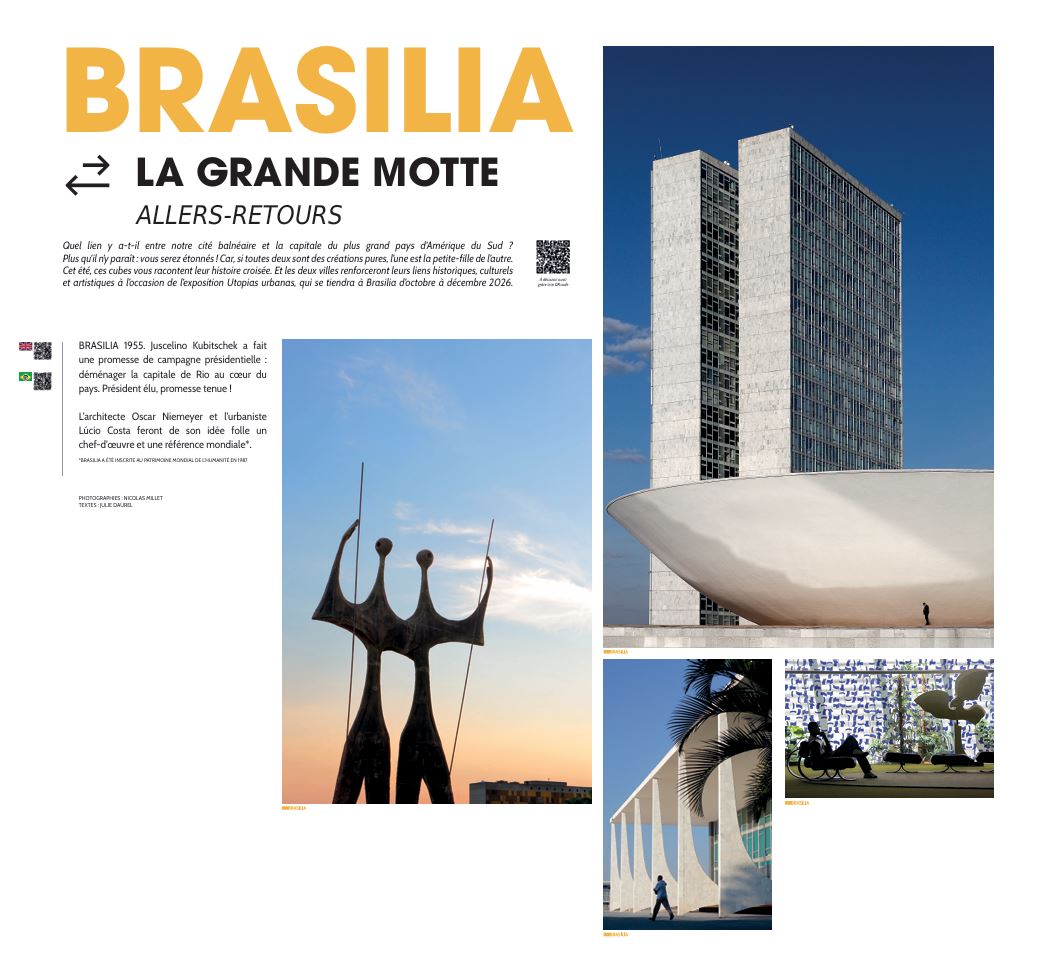
What is the connection between our coastal city and the capital of South America’s largest country?
More than meets the eye: you’ll be surprised! Because, although both are entirely original creations, one is the granddaughter of the other.
This summer, these cubes will tell you their intimately linked story. And the two cities will strengthen their historical, cultural, and artistic ties during the Utopias Urbanas exhibition, which will be held in Brasília from October to December 2026.
BRASILIA 1955. During his presidential campaign, Juscelino Kubitschek promised to move the capital from Rio to the heart of the country. Elected president, he kept his promise! The architect Oscar Niemeyer and the urban planner Lúcio Costa would transform his audacious idea into a masterpiece and a global icon.
*Brasilia was inscribed on the World Heritage List in 1987
TRADUCTION
CUBE 1
Face 2
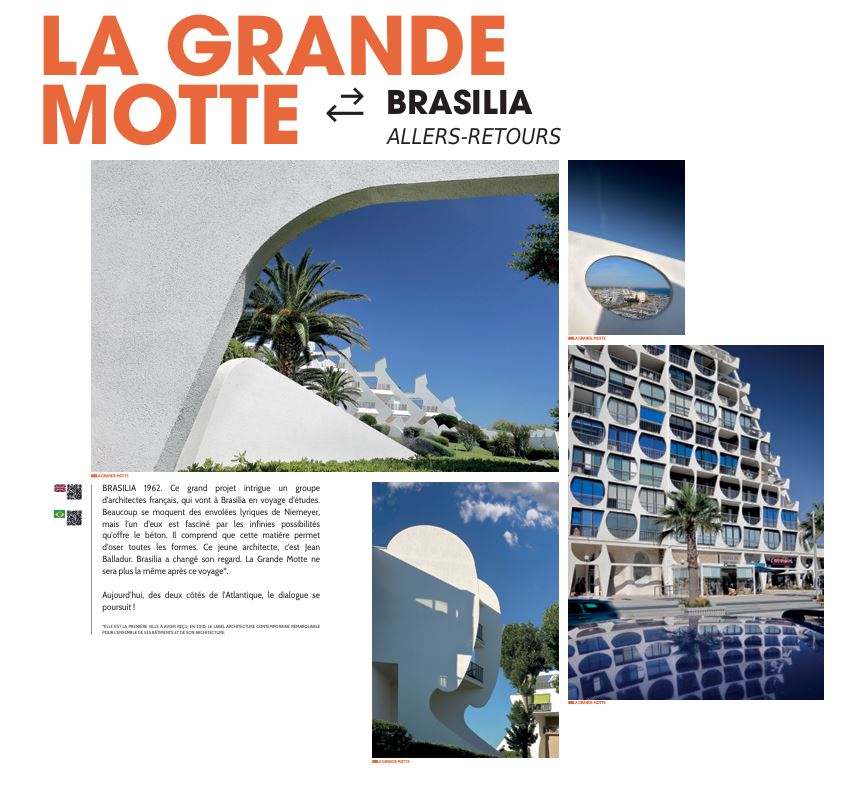
BRASILIA 1962. This great project intrigued a group of French architects who came to Brasilia for a study trip. Many scoffed at Niemeyer’s lyrical pronouncements, but one of them was captivated by the infinite possibilities offered by concrete. He understood that this material allowed for the exploration of all forms. This young architect was Jean Balladur. Brasilia changed his perspective. La Grande Motte would never be the same after that trip. Today, on both sides of the Atlantic, the dialogue continues!
It was the first city to receive, in 2010, the « Remarkable Contemporary Architecture » label for its buildings and architecture.
TRADUCTION
CUBE 1
Face 3
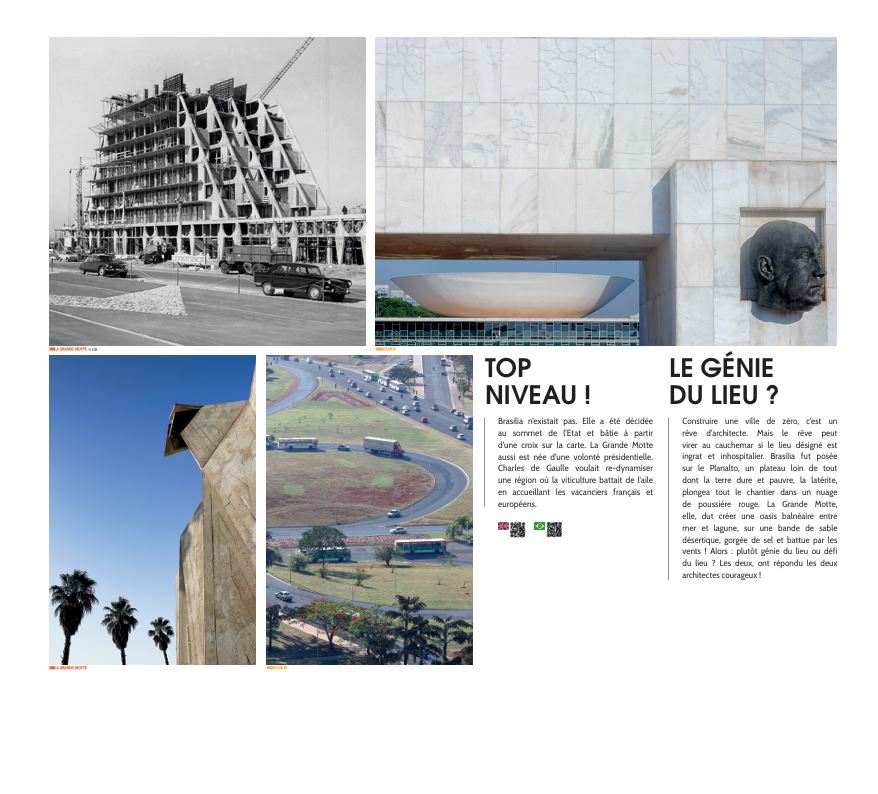
Brasilia did not yet exist. Its creation was decided at the highest level of the State and built from a cross on the map. La Grande Motte also originated from a presidential initiative. Charles de Gaulle wanted to revitalize a region where viticulture was struggling by attracting French and European tourists.
Building a city from scratch is every architect’s dream. But this dream can turn into a nightmare if the chosen site is hostile and inhospitable. Brasilia was built on the Planalto, an isolated plateau whose hard, poor soil, laterite, enveloped the construction site in a cloud of red dust. La Grande Motte, on the other hand, had to create a seaside oasis, between the sea and a lagoon, on a strip of desert sand, saturated with salt and swept by the winds! So: genius loci or challenge of the site? Both, answered the two audacious architects!
TRADUCTION
CUBE 1
Face 4
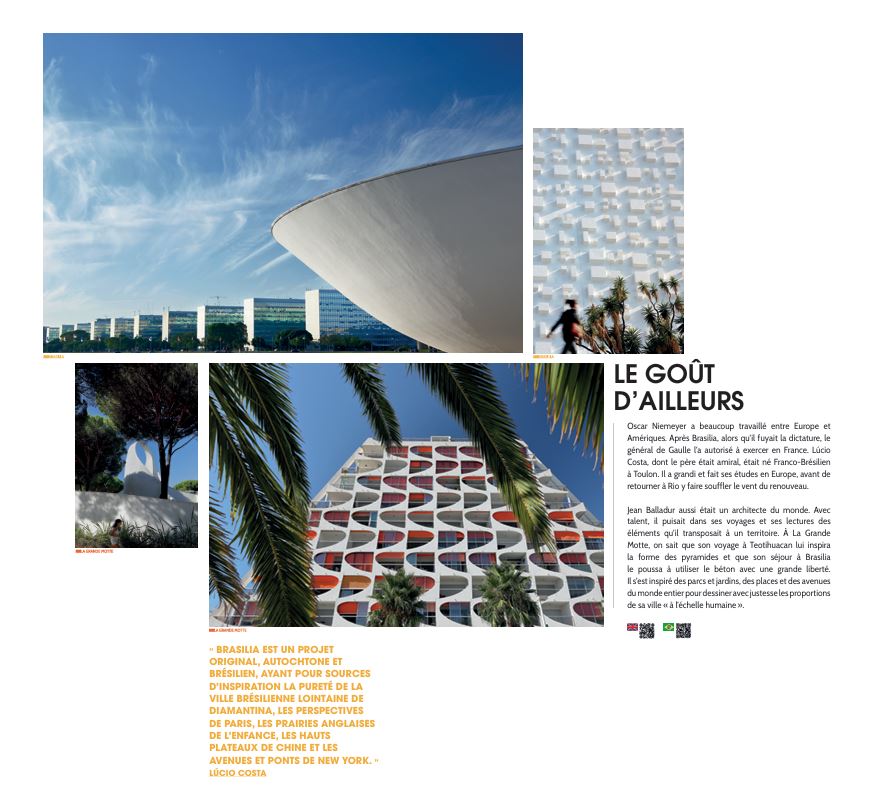
Oscar Niemeyer worked extensively between Europe and the Americas. After Brasília, fleeing the dictatorship, General de Gaulle allowed him to practice in France. Lúcio Costa, the son of an admiral, was born in Toulon, France, of Franco-Brazilian heritage. He grew up and studied in Europe before returning to Rio to instill a spirit of renewal. Jean Balladur was also a cosmopolitan architect. Talented, he drew inspiration from his travels and reading, transposing architectural elements to specific territories. In La Grande Motte, it is known that his trip to Teotihuacan inspired the shape of the pyramids and that his time in Brasília encouraged him to use concrete with great freedom. He drew inspiration from parks and gardens, squares and avenues around the world to precisely design the proportions of his city, « on a human scale. »
“BRASILIA IS AN ORIGINAL, AUTHENTIC, AND BRAZILIAN PROJECT, INSPIRED BY THE PURITY OF THE BRAZILIAN CITY OF DIAMANTINA, THE VIEWS OF PARIS, THE ENGLISH PRAIRIES OF CHINA, THE HIGH PLATS OF CHINA, AND THE AVENUAS AND BRIDGES OF NEW YORK.”
LÚCIO COSTA
TRADUCTION
CUBE 2
Face 1
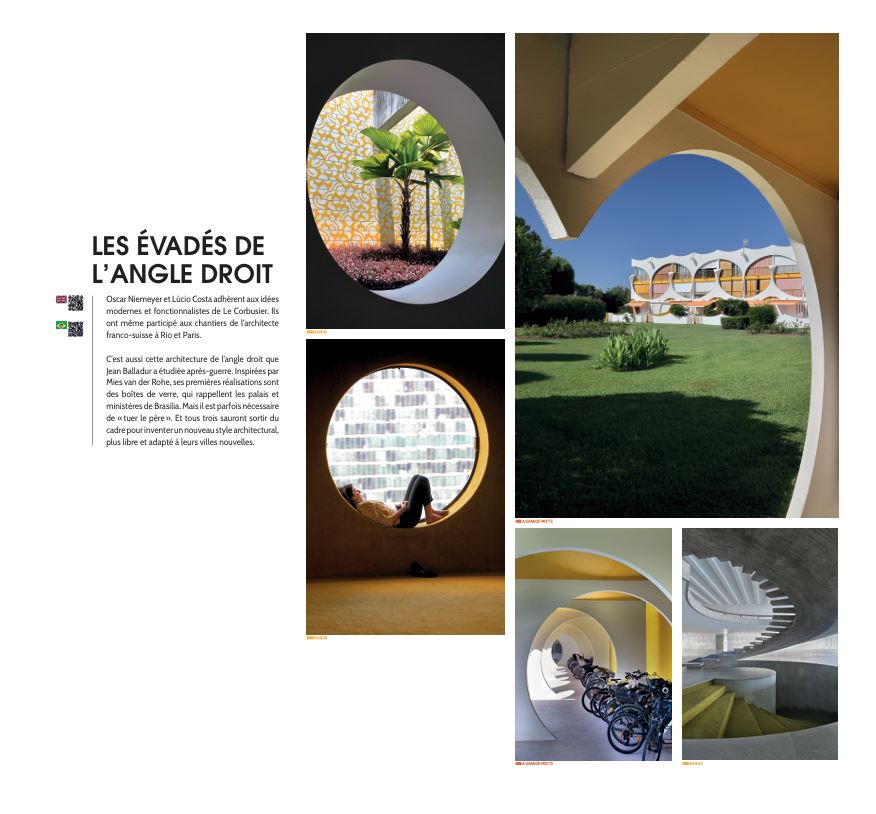
Oscar Niemeyer and Lúcio Costa embraced Le Corbusier’s modern and functionalist ideas. They even participated in the Franco-Swiss architect’s projects in Rio and Paris. It was also this architecture of right angles that Jean Balladur studied after the war. Inspired by Mies van der Rohe, his early works were glass boxes, reminiscent of the palaces and ministries of Brasília. But sometimes one must « kill the father. » And all three broke free from conventions to invent a new architectural style, freer and better suited to their new cities.
TRADUCTION
CUBE 2
Face 2
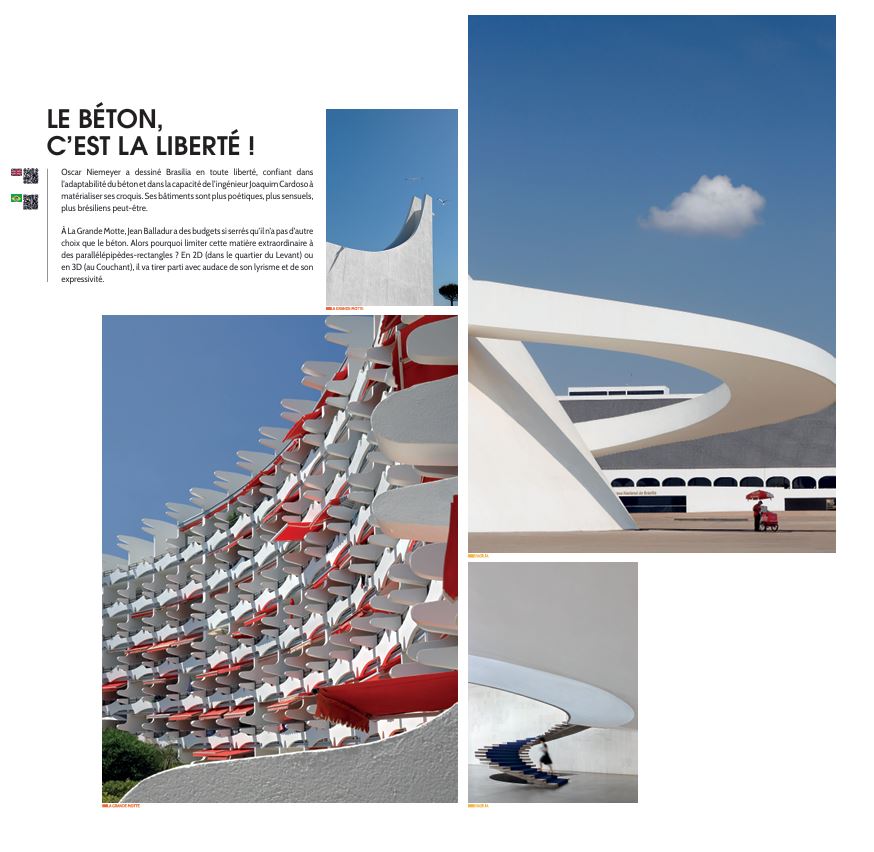
Oscar Niemeyer designed Brasília with complete freedom, relying on the adaptability of concrete and the talent of engineer Joaquim Cardoso to bring his sketches to life. His buildings are more poetic, more sensual, perhaps more Brazilian. In La Grande Motte, Jean Balladur, faced with such strict budgetary constraints, had no other choice but concrete. So why limit this extraordinary material to rectangular parallelepipeds? In two dimensions (in the Levant district) as well as in three dimensions (in the Couchant district), he boldly exploited its lyricism and expressiveness.
TRADUCTION
CUBE 2
Face 3
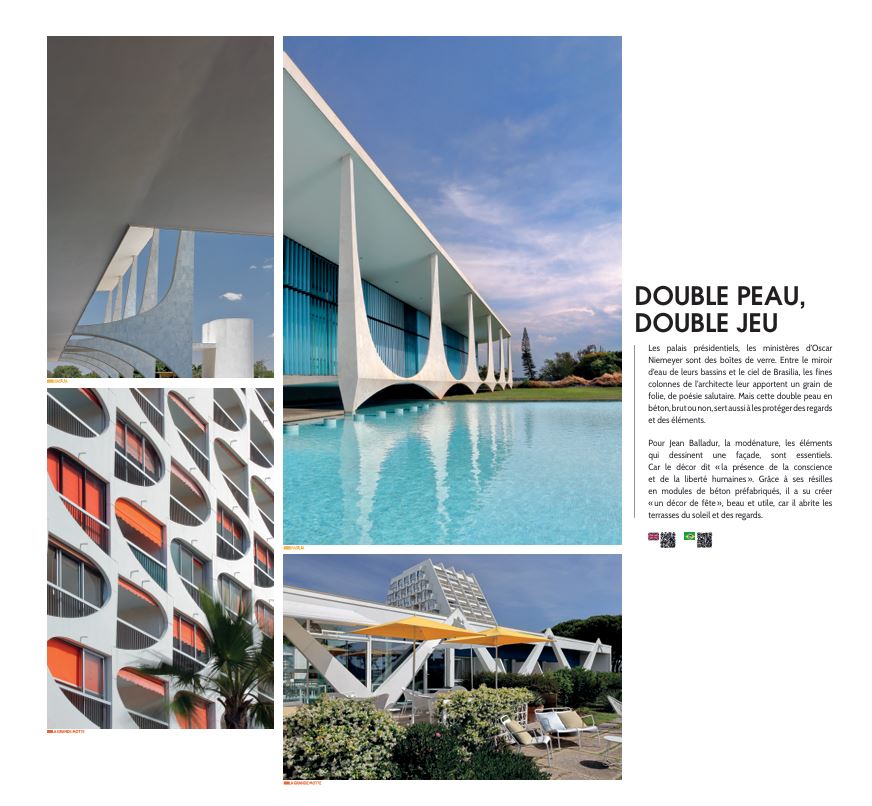
Oscar Niemeyer’s presidential palaces and ministries are glass boxes. Between the reflection of their pools and the Brasilia sky, the architect’s slender columns lend them a touch of whimsy, a welcome poetry. But this double skin of concrete, raw or polished, also protects them from prying eyes and the elements. For Jean Balladur, moldings, those elements that define a façade, are essential. Because decoration expresses « the presence of human consciousness and freedom. » Thanks to his latticework of prefabricated concrete modules, he created a festive setting, both beautiful and functional, that shelters the terraces from the sun and prying eyes.
TRADUCTION
CUBE 2
Face 4
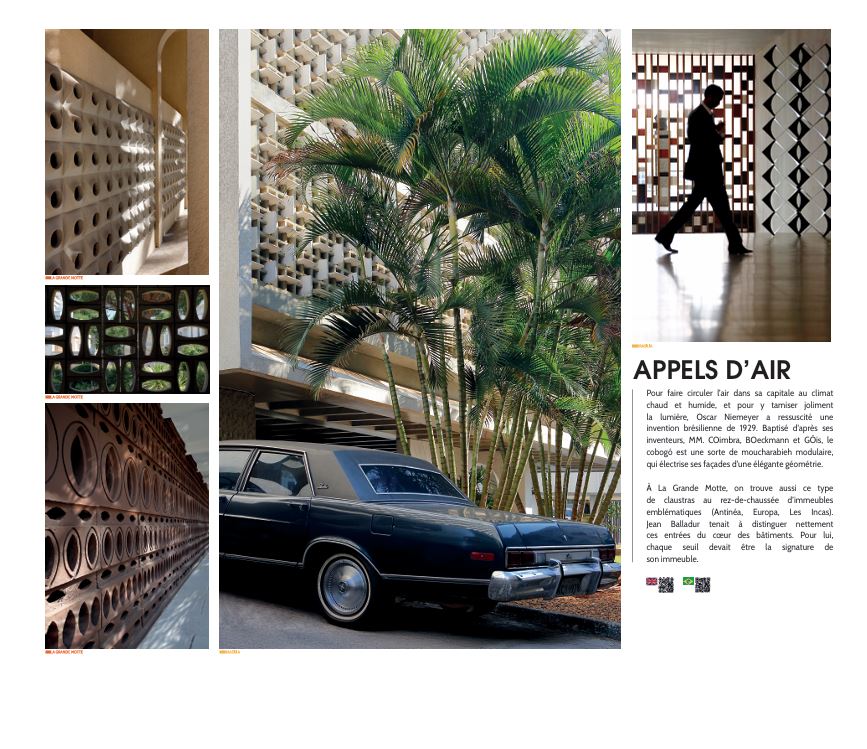
To circulate air in his capital, with its hot and humid climate, and to filter light with elegance, Oscar Niemeyer revived a Brazilian invention from 1929. Named after its inventors, Messrs. Coimbra, Boeckmann, and Góis, the cobogó is a type of modular mashrabiya that electrifies facades with its refined geometry. In La Grande Motte, this type of mashrabiya can also be found on the ground floors of iconic buildings (Antinéa, Europa, Les Incas). Jean Balladur was keen to clearly distinguish these entrances from the heart of the buildings. For him, each threshold had to be the signature of his building.
TRADUCTION
CUBE 3
Face 1
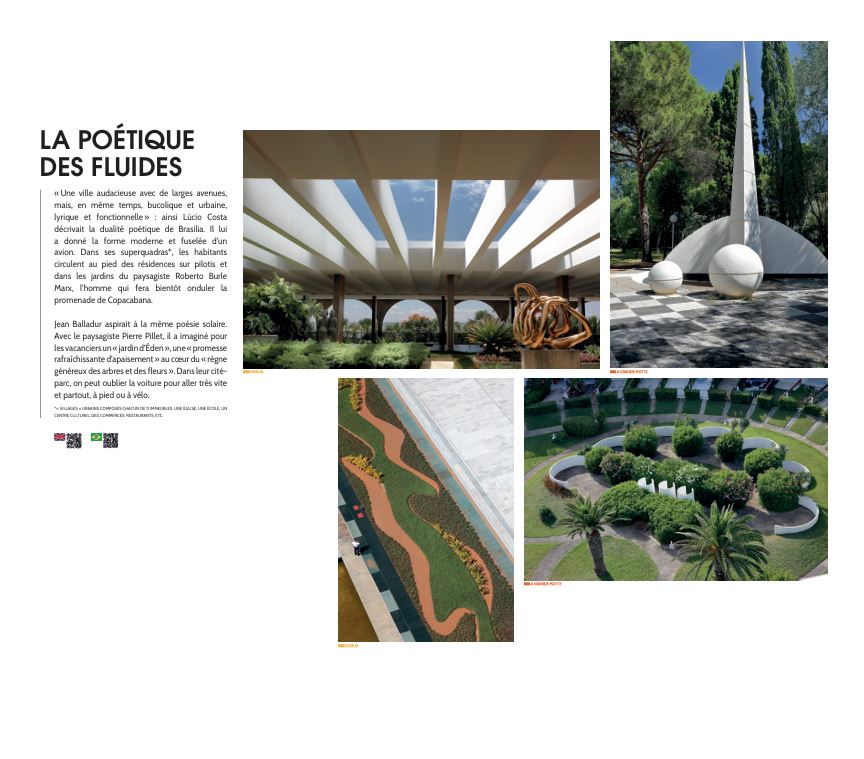
THE POETICS
“A bold city with wide avenues, but at the same time, bucolic and urban, lyrical and functional”: this is how Lúcio Costa described the poetic duality of Brasília. He gave it the modern, streamlined shape of an airplane. In its superblocks*, residents walk at the foot of buildings on stilts and in the gardens of landscape architect Roberto Burle Marx,
the one who would soon give the Copacabana promenade its characteristic undulations.
Jean Balladur aspired to this same sun-drenched poetry. With landscape architect Pierre Pillet, he envisioned forvacationers a “Garden of Eden,” a “promise of refreshing tranquility” at the heart of a “generous realm of trees and flowers.” In their garden city, one can forget about the car and get around very quickly and everywhere, on foot or by bicycle.
*URBAN « VILLAGES » EACH COMPOSED OF 11 BUILDINGS, A CHURCH, A SCHOOL, A CULTURAL CENTER, SHOPS, RESTAURANTS, ETC.
TRADUCTION
CUBE 3
Face 2
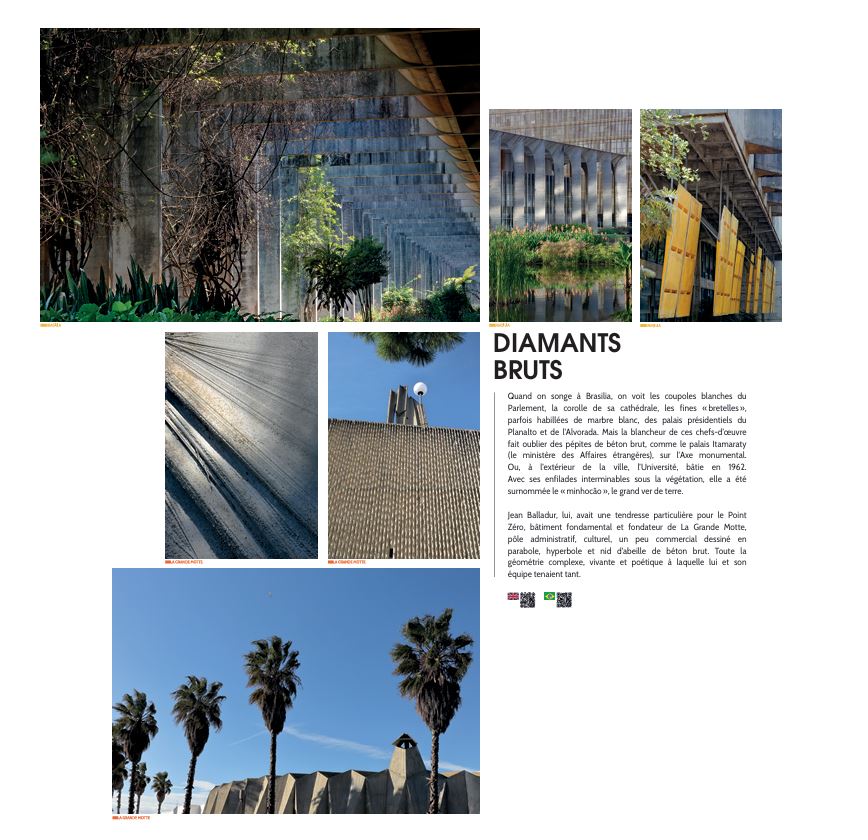
RAW DIAMONDS
When we think of Brasília, we picture the white domes of the Parliament, the corolla of its cathedral, the slender « bands, » sometimes clad in white marble, of the presidential palaces of the Planalto and the Alvorada. But the whiteness of these masterpieces overshadows the raw concrete gems, such as the Itamaraty Palace (the Ministry of Foreign Affairs), on the Monumental Axis.
Or, outside the city, the University, built in 1962.With its endless rows of buildings nestled amidst the vegetation, it has been nicknamed the « minhocão, » the great earthworm.
Jean Balladur, for his part, was particularly fond of Point Zero, a fundamental and foundational building in La Grande Motte, an administrative, cultural, and, to some extent, commercial center, designed as a parable, a hyperbolic, and honeycomb-like structure of raw concrete. All that complex, vibrant and poetic geometry that he and his team cherished so much.
TRADUCTION
CUBE 3
Face 3
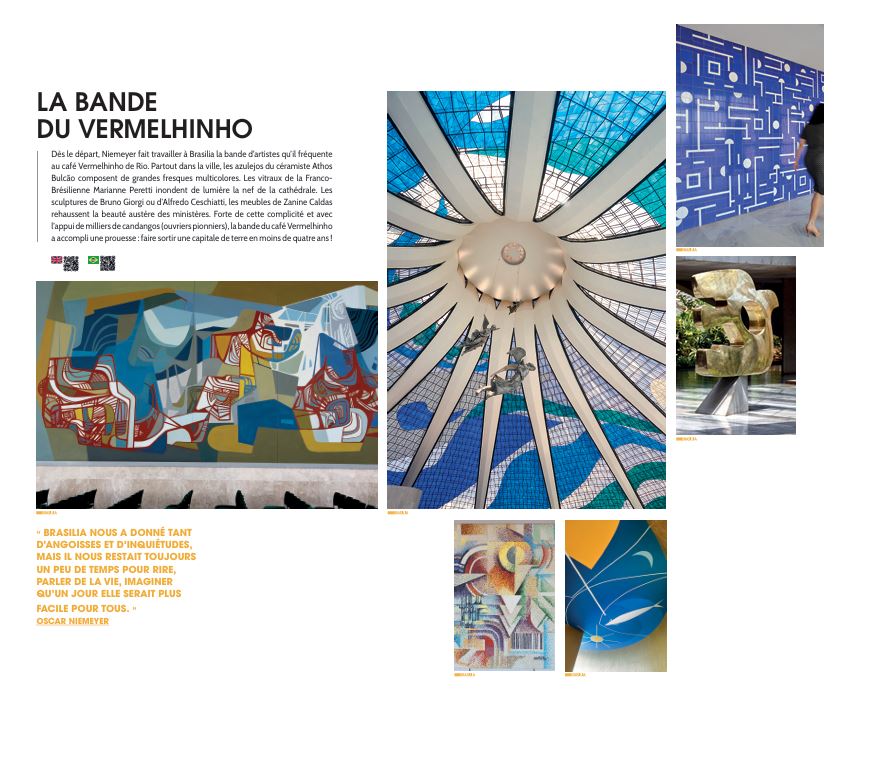
THE VERMELHINHO GROUP
From the outset, Niemeyer employed in Brasília the group of artists he had frequented at the Café Vermelhinho in Rio. Throughout the city, the azulejos of ceramicist Athos Bulcão formed vast, multicolored frescoes. The stained-glass windows of the Franco-Brazilian artist Marianne Peretti flooded the nave of the cathedral with light. The sculptures of Bruno Giorgi and Alfredo Ceschiatti, as well as the furniture of Zanine Caldas, enhanced the austere beauty of the government ministries. Strengthened by this collaboration and thanks to the support of thousands of candangos (pioneers), the Café Vermelhinho group accomplished a remarkable feat: building a capital city ex nihilo in less than four years!
“Brasilia caused us so much anguish and worry, but we still had a little time left to laugh, to talk about life, to imagine that one day things would be easier for everyone.”
TRADUCTION
CUBE 3
Face 4
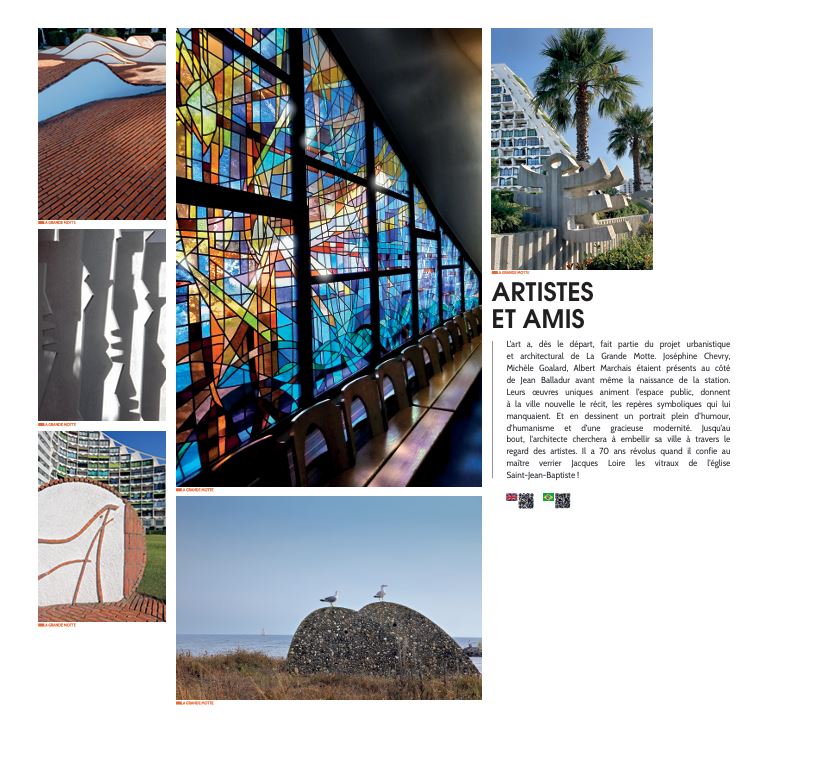
ARTISTS AND FRIENDS
From the outset, art was an integral part of the urban planning and architectural project of La Grande Motte. Joséphine Chevry, Michèle Goalard, and Albert Marchais were working alongside Jean Balladur even before the seaside resort was built. Their unique works enliven the public spaces, providing the new town with the narrative and symbolic landmarks it lacked. They also paint a portrait imbued with humor, humanism, and elegant modernity. Until the very end, the architect sought to beautify his town through the eyes of artists. He was 70 years old when he commissioned the stained-glass windows of the Church of Saint John the Baptist from the master glassmaker Jacques Loire.